
Tears in the Tabernacle
Mother's Day Edition: 1 Samuel 1:1-2:11

Read
1 Samuel 1:1–28 (ESV)
1 There was a certain man of Ramathaim-zophim of the hill country of Ephraim whose name was Elkanah the son of Jeroham, son of Elihu, son of Tohu, son of Zuph, an Ephrathite. 2 He had two wives. The name of the one was Hannah, and the name of the other, Peninnah. And Peninnah had children, but Hannah had no children.
3 Now this man used to go up year by year from his city to worship and to sacrifice to the Lord of hosts at Shiloh, where the two sons of Eli, Hophni and Phinehas, were priests of the Lord. 4 On the day when Elkanah sacrificed, he would give portions to Peninnah his wife and to all her sons and daughters. 5 But to Hannah he gave a double portion, because he loved her, though the Lord had closed her womb. 6 And her rival used to provoke her grievously to irritate her, because the Lord had closed her womb. 7 So it went on year by year. As often as she went up to the house of the Lord, she used to provoke her. Therefore Hannah wept and would not eat. 8 And Elkanah, her husband, said to her, “Hannah, why do you weep? And why do you not eat? And why is your heart sad? Am I not more to you than ten sons?”
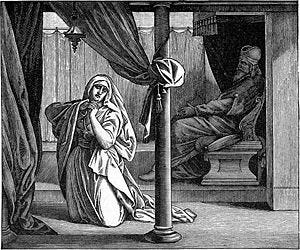
9 After they had eaten and drunk in Shiloh, Hannah rose. Now Eli the priest was sitting on the seat beside the doorpost of the temple of the Lord. 10 She was deeply distressed and prayed to the Lord and wept bitterly. 11 And she vowed a vow and said, “O Lord of hosts, if you will indeed look on the affliction of your servant and remember me and not forget your servant, but will give to your servant a son, then I will give him to the Lord all the days of his life, and no razor shall touch his head.”
12 As she continued praying before the Lord, Eli observed her mouth. 13 Hannah was speaking in her heart; only her lips moved, and her voice was not heard. Therefore Eli took her to be a drunken woman. 14 And Eli said to her, “How long will you go on being drunk? Put your wine away from you.” 15 But Hannah answered, “No, my lord, I am a woman troubled in spirit. I have drunk neither wine nor strong drink, but I have been pouring out my soul before the Lord. 16 Do not regard your servant as a worthless woman, for all along I have been speaking out of my great anxiety and vexation.” 17 Then Eli answered, “Go in peace, and the God of Israel grant your petition that you have made to him.” 18 And she said, “Let your servant find favor in your eyes.” Then the woman went her way and ate, and her face was no longer sad.
19 They rose early in the morning and worshiped before the Lord; then they went back to their house at Ramah. And Elkanah knew Hannah his wife, and the Lord remembered her. 20 And in due time Hannah conceived and bore a son, and she called his name Samuel, for she said, “I have asked for him from the Lord.
21 The man Elkanah and all his house went up to offer to the Lord the yearly sacrifice and to pay his vow. 22 But Hannah did not go up, for she said to her husband, “As soon as the child is weaned, I will bring him, so that he may appear in the presence of the Lord and dwell there forever.” 23 Elkanah her husband said to her, “Do what seems best to you; wait until you have weaned him; only, may the Lord establish his word.” So the woman remained and nursed her son until she weaned him. 24 And when she had weaned him, she took him up with her, along with a three-year-old bull, an ephah of flour, and a skin of wine, and she brought him to the house of the Lord at Shiloh. And the child was young. 25 Then they slaughtered the bull, and they brought the child to Eli. 26 And she said, “Oh, my lord! As you live, my lord, I am the woman who was standing here in your presence, praying to the Lord. 27 For this child I prayed, and the Lord has granted me my petition that I made to him. 28 Therefore I have lent him to the Lord. As long as he lives, he is lent to the Lord.” And he worshiped the Lord there.
Explain
Maybe you have never thought about this, but the storyline of salvation is carried along by the stories of mothers. Redemptive history starts with the mother of all living (Eve). In the beginning God created the heavens and the earth, and it was perfect. There was no sin, shame, or effects therein. God walked among his people, and it was glorious, but short lived. Adam and Eve sinned by rejecting God. They chose the creation over the creator. Immediately Adam and Eve knew they were naked and they were filled with shame. The world that was full of beauty and life, had been broken. The consequences were sin, and death. You expect God to deal out his wrath and start again. He would be right and just to do so, but that is not the story. God speaks gospel over them.
God curses the serpent and says, “I will put enmity between you and the woman, and between your offspring and her offspring; he shall bruise your head, and you shall bruise his heel (Gen 3:15).” Through the woman there will be a Son who come crush the serpent and undo the effects of sin and death. This sets up the rest of the bible, looking for the seed of the woman. Redemptive History begins.
Women are the linchpin of redemptive history. Many of the transitions and movements of salvation start with women. Barren women are markers in the biblical storyline that God is about to act on behalf of his people. This pattern starts with Sarah. Abraham and Sarah follow God to a distant land and await the birth of children, only Sarah is barren. Yet, God speaks a better word and she conceives a child of promise named Isaac. Redemptive history continues.
Issac inherits God’s promise to Abraham, and receives a barren wife in Rebekah (Gen 25:21). How will the promises of God continue? God takes barren wombs and makes them bountiful. Rebekah conceives and gives birth to Jacob and Esau. Redemptive history continues.
Jacob grows up and takes Leah and Rachel as his wives.1 Leah is fertile and has many children. But Rachel is barren. Her womb is closed. If you have not caught on, God loves to take broken and barren women and make them bountiful for his own redemptive plans and purposes. We know how the story goes, Rachel eventually conceives Joseph and Benjamin. Leah conceives and has Judah and many more sons. Redemptive history continues.
From the children of Rachel and Leah, the descendants of Abraham go into Egypt and grow into a great multitude. Israel becomes so great that Pharaoh enslaves God’s people from fear of revolt and war. This sets the stage for the next great epoch of redemptive history.
Exodus is all about deliverance. The first deliverance in Exodus is the children of Israel through the faithfulness and courage of Moses’ mother, along side the Egyptian house wives. These women valiantly choose to obey God, rather than men. They protect the children of the promise at all cost. Redemptive history continues.
Following the exodus, Israel enters the land and falls into the curses of the covenant. Idolatry and wickedness are rampant amongst God’s people. They are oppressed under the tyranny of the Philistines. Where is the deliverer? Enter the wife of Manoah. Manoah’s wife is barren and unable to conceive children. God speaks to his wife and promises a son who shall, “begin to save Israel from the hand of the Philistines.” Sampson is born soon after. Redemptive history continues.
Hannah’s Plight
1 There was a certain man of Ramathaim-zophim of the hill country of Ephraim whose name was Elkanah the son of Jeroham, son of Elihu, son of Tohu, son of Zuph, an Ephrathite. 2 He had two wives. The name of the one was Hannah, and the name of the other, Peninnah. And Peninnah had children, but Hannah had no children.
The book of Judges is chaos. There is no order, nor is there right worship of Yahweh. Judges marks Israel’s darkest hour. Israel needs a king. The book of Samuel is all about the coming of a king.2 First we see king Saul, followed by the predominant king of the Old Testament, David. You would expect this book to start with a genealogy of the king, or to open with the king’s mother. Instead this book opens with an obscure list of names and places. That is the point. God is going to use the humble things of the world to turn Israel upside down. The story of the great kings of old, starts not with might and strength, but in obscurity and weakness.
Elkanah a Levite living in the hill country of Ephraim, has two wives.3 Hannah and Peninnah. Verse two ends with a devastating line, “but Hannah had no children.”
At this time, children were everything. They were necessary for the economy of the home. They were needed for geopolitical saftey. Children were needed to work around the house, and carry the family name forward. Children were understood to be a predominant sign of God’s faithfulness to His people. Rearing children, was an important aspect of worship (Deuteronomy 6.) But Hannah had none.
It is suggestive that Hannah is mentioned first in the text. She was most likely Elkanah’s first wife, but after years of infertility, he took a second wife to have children. She was not enough. Elkanah should have responded in faith and sought the Lord alongside his bride, but like his fathers before him he trusted in his own strength.
Hannah’s Pain
3 Now this man used to go up year by year from his city to worship and to sacrifice to the Lord of hosts at Shiloh, where the two sons of Eli, Hophni and Phinehas, were priests of the Lord. 4 On the day when Elkanah sacrificed, he would give portions to Peninnah his wife and to all her sons and daughters. 5 But to Hannah he gave a double portion, because he loved her, though the Lord had closed her womb. 6 And her rival used to provoke her grievously to irritate her, because the Lord had closed her womb. 7 So it went on year by year. As often as she went up to the house of the Lord, she used to provoke her. Therefore Hannah wept and would not eat
Despite Elkanah’s marital misjudgments, he was a true worshiper of Yahweh. Remember, this is during the time of the Judges, that is not a given. There was no temple at this time, so worship would take place at the tabernacle in Shiloh. Elkanah was not an evil man, though misguided, he loved Yahweh and he loved Hannah.
Elkanah would give Peninnah and his children a single portion of food, but Hannah would receive double. He loved her in-spite of her barrenness. To make matters worse for Hannah, she had an enemy in the house. Peninnah would provoke her, or as the Hebrew reads “thunder against her.” She had a rival in her own home. Peninnah, out of her own insecurities and short comings would rail agaisnt her. She knew the button to press. “I have brought my husband many children. Yahweh has blessed my womb beyond mesure, but you are just a barren women. I have given children of promise, you have none.” Imagine the pain, and sorrow. Imagine Hannah’s brokenness. Look at verse 7, “year by year.” This was not a brief season of suffering, this was Hannah’s life. He pain brought many tears and would not be sated by food or drink. Where is her comfort? Where is her hope?
Hannah’s Prayer
After they had eaten and drunk in Shiloh, Hannah rose. Now Eli the priest was sitting on the seat beside the doorpost of the temple of the Lord. 10 She was deeply distressed and prayed to the Lord and wept bitterly. 11 And she vowed a vow and said, “O Lord of hosts, if you will indeed look on the affliction of your servant and remember me and not forget your servant, but will give to your servant a son, then I will give him to the Lord all the days of his life, and no razor shall touch his head.”
After everyone eats and drinks, Hannah rose. She goes to the tabernacle, but she does not go to Eli. She does not take her grief and suffering to her husband, nor does she go to the priest. She is overwhelmed with suffering and sorrow. “She was deeply distressed and prayed to the Lord and wept bitterly.” She takes her tears to the tabernacle. This is a great example for us in faith.
First, Hannah turns to the Lord in prayer. She took her grief and anguish to God. This might seem simplistic, but this is an important response of faith. Peninnah, who is boastful and proud, and has everything she needs. When trouble befalls her, she will turn to her husband, or to her many children. But Hannah who is broken, and desperate, turns to the Lord God Almighty. She knows that Charm is deceitful, and beauty is vain but a woman who fears the Lord is great to be praised (Proverbs 31:31). She knows that there is no hope for her in life and death except God. Hannah’s prayer is a posture of humility. She confesses her dependance upon God to satisfy her need. Those who walk by faith, bring their tears to the Lord.
Second, Hannah confesses God’s strength and her weakness “O LORD of Host.” In Hebrew, Yahweh Sabaoth, the Lord of Host. This is a title of strength. This is the living God who rules the armies and legions of angels. This is a majestic title. Hannah knows the God she worships. She knows that he is mighty, strong, and magnificent. She knows that he is the sovereign creator of heaven and earth. This is her confession!
She also confesses her need. She prays, “if you will indeed look upon my affliction of your servant.” Hannah is borrowing language from the exodus. God tells Moses,that He has indeed seen the affliction of his people, and heard their cries (Exodus 3:7) Hannah is rehearsing redemptive history in her prayers.
She knows about Sarah, Rebekah, Rachel, and Manoah’s wife. She knows that same God who closes the womb, also opens the womb. Hannah belives that God looks upon the affliction of his people, and he is not indifferent. Hannah trusts that God keeps his promises, and she asks the Lord to do it again.
Hannah also prayed with holy motives. Look at her request, “if you give your servant a son, I will give him to the Lord all the days of his life, and not a razor shall touch his head.” This might seem like a bargin, but i’m not sure we should read it that way. Without doubt she wanted a child, but more importantly she wanted a child who would be dedicated to Yahweh. She did not want a child for her own glory, but for the glory of the King. Hannah was willing to forgo her claim on this child. She would not get to raise the child she desired. He will be dedicated to the Lord all the days of his life. This child would be under a nazarite vow, meaning they would abstain from fruit of the vine, and would never cut his hair. This was a visible symbol that he was set apart to Yahweh. The child she desires, is not her own, but belongs wholly to God.
While Hannah prays before the Lord, the priest Eli mistakes her faith for folly. He assumes she is a worthless woman, who is drunk at the tabernacle. He says, “
“How long will you go on being drunk? Put your wine away from you.” 15 But Hannah answered, “No, my lord, I am a woman troubled in spirit. I have drunk neither wine nor strong drink, but I have been pouring out my soul before the Lord. 16 Do not regard your servant as a worthless woman, for all along I have been speaking out of my great anxiety and vexation.””
In other-words, Eli he is spiritually blind. He doesn't even know what true godliness looks like. We would expect Eli to be a great man of spiritual truth, and insight. Instead he misses the mark. This man is representative of someone powerful and close to God, but in reality this woman from the hills and hollers of Ephraim, has more spiritual insight and humility. She was not drunk, but was pouring out her heart to God. Hannah defends herself, not as a woman of destruction, but as a believer seeking Yahweh.
The author of Samuel shows divine irony here. Eli, the priest has neglected to instruct his children in the fear and admonition of the Lord. Eli’s two sons, are drunks, thieves, and whoremongers. They abuse their power, and take advantage of the poor. Yahweh will ultimately put them to death. Meanwhile, Hannah, will dedicate her son to Yahweh all the days of his life.
In the end Eli blesses Hannah saying, “Go in peace, and the God of Israel grant your petition that you have made to him.”
Look at what happens next, “20 And in due time Hannah conceived and bore a son, and she called his name Samuel, for she said, “I have asked for him from the Lord.””
The Lord answered her prayer and petition. This is incredible. She gets up, she eats, and goes home. Hannah’s womb is open and she conceives a child. Make no mistake, this is an answered prayer. This is no mistake. God opens her womb.
There is more irony by the fact of her name. Did you know that Hannah’s name means grace? This story opens with Hannah and Peninnah. Peninah’s name means perl, or precious stone. One is full of pride and boastful of her children and status. The other, is humble, broken, contrite, but an example of faith. Hannah is a fitting name, considering she did not open her own womb. The same God that closed it, opened it. It was a grace. It was unmerited favor. She knows that this is a work of God alone, and she responds in praise.
Hannah’s Praise
2:1 And Hannah prayed and said,
“My heart exults in the Lord;
my horn is exalted in the Lord.
My mouth derides my enemies,
because I rejoice in your salvation.
2 “There is none holy like the Lord:
for there is none besides you;
there is no rock like our God.
3 Talk no more so very proudly,
let not arrogance come from your mouth;
for the Lord is a God of knowledge,
and by him actions are weighed.
4 The bows of the mighty are broken,
but the feeble bind on strength.
5 Those who were full have hired themselves out for bread,
but those who were hungry have ceased to hunger.
The barren has borne seven,
but she who has many children is forlorn.
6 The Lord kills and brings to life;
he brings down to Sheol and raises up.
7 The Lord makes poor and makes rich;
he brings low and he exalts.
8 He raises up the poor from the dust;
he lifts the needy from the ash heap
to make them sit with princes
and inherit a seat of honor.
For the pillars of the earth are the Lord’s,
and on them he has set the world.
9 “He will guard the feet of his faithful ones,
but the wicked shall be cut off in darkness,
for not by might shall a man prevail.
10 The adversaries of the Lord shall be broken to pieces;
against them he will thunder in heaven.
The Lord will judge the ends of the earth;
he will give strength to his king
and exalt the horn of his anointed.”
It would be easy for Hannah to become pregnant, and immediately take the glory. Instead, she gives all honor, and praise to God alone. She knows that it is the Lord who is over all the earth. He makes rich, and poor. He raises to life, and strikes down to death. He satisfies the weary, but makes the full hungry. The Lord exalts the humble but opposes the proud. Yahweh’s hands are not bound, he is willing and able to save those who humble themselves before him. Redemptive history continues.
Apply
Children are a blessing from the Lord
Today we don’t think in these categories. But in the ancient world barrenness would be a disaster. Our culture rejects children. Kids are seen as a burden and obstacle to life goals and ambitions. Let us remember that children are a precious gift from God. In the very beginning, children were the means that God had given Adam and Eve to spread the glory of God though the whole creation. He said, “be fruitful and multiply.” Children are a gift from God, and it’s God’s design that we would fill the world with his little image bearers.
Sovereignty and suffering
Many couples wonder why they cannot have children, but the author of 1 Samuel tells us outright that the Lord had closed Hannah’s womb. This is significant, and I think that this is telling about Hannah’s faith. She knows that God is sovereign. She knows God is over all things. She is hardly the first woman in Israel’s history to be barren. She might not understand, the why of God’s plans and purposes in her barreness. But she knows that the One who had closed her womb, is the only One who is able to open it. She knows that as God watches over the fertility of the fields, and sustains and provides all their needs, is completely in control of her womb, and her capacity to have children.
This reminds me of John 9, when the disciples asked Jesus about the blind man. They said, “And his disciples asked him, “Rabbi, who sinned, this man or his parents, that he was born blind?” Jesus answered, “It was not that this man sinned, or his parents, but that the works of God might be displayed in him.” In other words, sometimes our suffering is part of God’s sovereign plan to redeem, heal, and restore us for his own glory.
Husbands cannot fix everything
“And Elkanah, her husband, said to her, “Hannah, why do you weep? And why do you not eat? And why is your heart sad? Am I not more to you than ten sons?” 1:8
You have to give him credit. Elkanah loves his wife, he sees her distress. He really cared. He comes to her, and he does what every man tries to do for a distressed wife, he tries to fix it. When I see my wife in pain, or distress, I want to do everything in my power to fix the problem and fill the void. He says, “Am I not more to you than ten sons?” To say it a different way, “is my love not enough?”
Sometimes husbands, your love is not enough. Hannah is lamenting over the fact that she is barren. She knows the reason, she is not looking to Elkanah to fix that problem, in fact his love and favor cannot fix that problem. She needs God to move. She needs God to look upon her affliction and meet her where she is at. Only God can understand and meet this need. Hannah does not need the comfort of Elkanah but she needs the comfort of Yahweh. Sometimes, wives need their husbands to sit in the brokenness and respond in faith.
This is descriptive and not prescriptive. Polygamy in the Bible is not God’s plan for marriage. Follow along with the story and you will plainly see the problems with multiple wives.
In the Hebrew Bible, 1 and 2 Samuel are one book.
1 Chronicles 6:27 records the genealogies of the Levites, this includes Elkanah.